

Personal Branding That Pops
Let’s be honest: figuring out how to present yourself and your personal brand can feel like trying to describe soup with interpretive dance. You know what you bring to the table (probably), but the moment someone says, “So what do you do?” your brain throws a blue screen error and you say something like, “I… do things with people? And also… Canva?”
Here’s the good news: You’re not alone. The even better news? You can clean this up. With a little strategy, some self-awareness, and just the right amount of sass, you can present yourself clearly and confidently without sounding like you swallowed a TED Talk.
Step 1: Get Uncomfortably Specific
Let’s start with the hardest part: clarity. That’s right — the one thing you’ve been dodging since you put “strategic visionary ninja” on your LinkedIn profile.
People need to understand what you do in seven words or less. If your answer to “what do you do?” needs a three-part docuseries and a mood board, start again.
Bad: “I’m a brand catalyst who facilitates transformation in the digital paradigm.”
Better: “I help small businesses grow with better marketing.”
Don’t fear the specifics. Embrace them like free tacos. If you’re a graphic designer who specializes in brand identity for female-led startups — say that. If you’re a dog trainer who works with anxious Pomeranians — say that. The more specific you are, the more people can refer you, hire you, or say, “Oh my God, I NEED you.”
Step 2: Pick a Lane — And Stay in It (Mostly)
Here’s a controversial statement: You can be multi-talented without marketing yourself like a chaotic buffet.
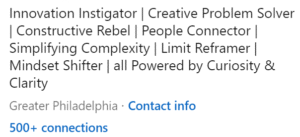
Saying “I do marketing, photography, accounting, and also Reiki” is… confusing. You’re not a Swiss Army knife; you’re a human. You can still do all those things, but the world needs a clear headline. This is an actual LinkedIn description of one on my connections:
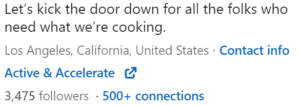
Here’s another LinkedIn about section. This person is smart and has some great IT product offerings, but you wouldn’t know that from this description.
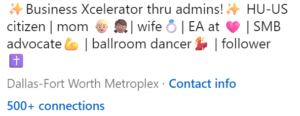
And lastly, I’m not sure if this person is an emoji queen or a business woman. Maybe she has a virtual assistance business (thru admins) but I’m not sure. It’s okay to have fun with your bio, but let us know who you help and how you help them.
When you finish this article go check your LinkedIn profile and see how clear your about section reads. Also, your Instagram bio should not read like a CVS receipt. Focus, friend.
Step 3: Show Don’t Tell
Want people to know you’re an expert? Show your work. Talk about your process. Share before/after, client stories. Let people see your genius, not just hear about it.
But also, don’t be afraid to be human. We are dangerously low on authenticity in the digital age. Let your voice, humor, and point of view shine through. A boring brand is an invisible brand. Be the reason someone snorts coffee out their nose at 9am.
Here’s an example: “I design logos that don’t look like a second grader made them in Microsoft Paint. Unless that’s your vibe. No judgment.” Now that’s memorable.
Step 4: Create a Signature Look
Visual branding matters. Pick 2–3 brand colors. Choose a typeface that doesn’t scream “early Pinterest fail.” Use the same headshot across platforms (bonus points if you’re smiling and don’t look like a haunted wax figure). Do not use a headshot where your arms are crossed. Any body language expert will tell you that presents as unapproachable
and stand-offish.

If you have a dark complexion or dark hair, the headshot should be a light background. If you have light hair or are bold (like me) then try a dark background for the photo. Contrast will make your head visible and not blend in to produce a floating face with no head.
People remember visuals. So whether you’re going for “Polished Professional,” “Whimsical Nerd,” or “CEO of Chaos,” make sure your visuals support your vibe.
And no, you don’t need to hire a brand consultant to choose your Instagram highlight colors — but you do need to be consistent. If your site is minimalist chic but your emails are written in Comic Sans, we have a problem.
Step 5: Practice Your Pitch
Your elevator pitch should feel authentic but confident. You don’t need to sound rehearsed — but you do need to sound prepared. Practice until it rolls off your tongue like your go-to Starbucks order. Example: “I’m a copywriter who helps startups sound less robotic and more like humans people actually want to buy from.”
Boom. Done. Next question?
Step 6: Don’t Just Tell Your Story — Live It
If your brand is “helping entrepreneurs find clarity,” but your site looks like a ransom note and your social feed is 97% selfies and brunch, we’ve got a disconnect.
Everything you put out into the world reinforces (or confuses) your brand. So think of your brand as your reputation’s stylist. Are you dressing it right? Are you walking your talk? Are you being who you say you are?
And remember — it’s okay to evolve. Just keep updating your message along the way. Creating clarity isn’t a one-time task
Final Thought:
Your personal brand isn’t a logo, a tagline, or a perfectly curated feed. It’s you — your personality, your skills, and the way people feel after interacting with you.
So stop overthinking it. Stop trying to sound like you read every self-help business book published since 2009. Just show up as yourself — clearly, confidently, and maybe a little weird. (The good kind.)
And for the love of marketing: please remove the phrase “guru” from your bio. You got this.
BONUS: Pro Tips to Level Up Your Brand
- Create a Content Pillar Strategy
Pick 3–5 core topics that align with your expertise and values. Use them to guide your social media posts, blog content, and podcast interviews. This creates consistency and positions you as an expert in those zones. - Google Yourself Regularly
Yes, it sounds vain, but it’s crucial. Search your name to see what pops up. Make sure your top results support your professional brand and update any outdated bios or old profile pictures lingering on forgotten platforms. - Get a Custom URL and Branded Email
Nothing says “I just started this yesterday” like emailing from ilovecheetos2020@gmail.com. Secure a domain and use a professional email like yourname@yourdomain.com. It’s a tiny investment with a big credibility return. When I see business emails that end with @aol or @yahoo their business credibility drops 50 points. - Use LinkedIn as a Landing Page, Not a Resume
Most people treat LinkedIn like a dusty digital resume. Why not try optimizing your headline, write a compelling About section, and fill your Featured section with results, testimonials, and thought leadership content. - Use Testimonials Strategically
Don’t wait for people to offer praise — ask happy clients for short testimonials that highlight your unique strengths. Use them on your website, LinkedIn, email signature, and proposals. - Be Findable — and Bookable
Add a link to your calendar or contact form in all your bios. Make it ridiculously easy for someone to contact or hire you. Every “DM me for rates” is a friction point. Don’t make people work for it. Removing friction takes the brakes off the wheel and makes it turn faster, resulting in more business and faster conversion times. - Brand Your Documents and Presentations
Even your invoices, proposals, and client welcome packets should reflect your visual brand. Use your fonts, colors, and tone of voice consistently, even in behind-the-scenes materials. - Audit Your Online Presence Quarterly
Set a reminder to check your social bios, link-in-bio tools, website copy, and pinned posts. Refresh anything that no longer fits your current focus or offers. - Don’t reply solely on AI to create content
AI is a powerful tool, but it requires human eyes to check validity and resonance for your audience. I like to collaborate with AI. I generate ideas or content and go back and forth with AI to produce a blended piece of content.